Hospitality Isn't About Rooms Or Tables. It's About Being There When Customers Need You.
"Customers remember how you made them feel long before they remember the room number."
I've always believed the hospitality industry has one job above all else: make people feel welcome. Whether you're running a hotel, restaurant, resort, spa, or guesthouse, customers want the same thing. They want quick answers, smooth experiences, and the feeling that somebody is there to help.
The problem is that hospitality businesses rarely operate under calm conditions. Calls arrive during check-ins. Reservation requests come during peak hours. Guests have questions after business hours. Meanwhile customers still expect immediate responses regardless of how busy your team happens to be.
That's why I think hospitality is one of the biggest beneficiaries of Voice AI. Not because AI is trendy. Not because it's the latest buzzword. Because hospitality businesses lose opportunities every single day when customers can't get answers quickly.
We recently discussed this challenge in How AI Voice Assistants Help Restaurants Capture More Reservations. The exact same pattern exists across hotels, resorts, and hospitality businesses. A missed inquiry often becomes a lost booking.
That's why I believe the future of hospitality customer service is increasingly tied to responsiveness. The businesses that answer first are often the businesses that win.
Great Hospitality Starts Before Guests Arrive.
Most hospitality businesses focus heavily on the guest experience after customers arrive. The room quality. The food. The amenities. The service. All of those things matter. But I've become convinced that customer experience starts much earlier than most businesses realize.
It starts with the first interaction. The first phone call. The first inquiry. The first reservation request. If that experience feels frustrating, delayed, or ignored, customers begin forming opinions about your business before they ever walk through the door.
That's why responsiveness has quietly become one of the most important competitive advantages in hospitality. Customers increasingly expect immediate answers, immediate assistance, and immediate confirmation that somebody is listening.
Hospitality businesses that consistently provide that experience create trust long before the guest experience officially begins.
What Happens When Every Guest Gets An Immediate Response?
See how RhythmiqCX helps hospitality businesses answer calls, capture bookings, and deliver exceptional guest experiences with Voice AI and AI phone receptionists.
Customers Don't Care Why You Missed The Call. They Only Notice That You Missed It.
This might sound a little harsh, but customers are surprisingly unforgiving when it comes to communication. They don't care that the front desk was busy checking guests in. They don't care that the restaurant was packed. They don't care that your team was dealing with another guest issue. They simply know they needed help and nobody responded.
That's why I think many hospitality businesses underestimate the cost of missed communication. Most owners track occupancy rates, bookings, guest reviews, and revenue obsessively. Very few track the opportunities that quietly disappear because nobody answered the phone. An unanswered question about room availability can become a booking at a competitor. A missed inquiry about event space can become somebody else's customer. A delayed response about reservations can create friction that never needed to exist in the first place.
This is where an ai voice assistant becomes incredibly valuable. Instead of sending customers to voicemail, businesses can answer instantly, collect information, handle FAQs, provide booking assistance, and route conversations appropriately. Guests receive immediate help while staff remain focused on delivering exceptional in-person service.
We touched on a similar idea in AI Agents for Small Businesses: What Actually Matters in 2026. The biggest AI wins often come from removing small operational bottlenecks that quietly cost businesses money every day. Hospitality happens to be full of those bottlenecks, and Voice AI removes many of them before customers ever notice.
Voice AI Finally Sounds Good Enough To Represent Your Brand.
Let's be honest. Traditional automated phone systems were never known for creating great customer experiences. Most customers tolerated them. Nobody actually enjoyed using them. Hospitality businesses are built on relationships, so forcing guests through robotic menus never felt aligned with the industry's core purpose.
That's exactly why recent advances in ai voice technologyfeel so significant. Modern systems powered by advanced speech to text api, Voice api, speech synthesis api, and text to speech ai infrastructure can understand natural conversations and respond in ways that feel dramatically more human. Guests no longer have to memorize menu options or navigate frustrating phone trees. They simply explain what they need, and the system responds accordingly.
We're also seeing major improvements in ai voice generator, voice synthesis ai, voice cloning software, ai voice cloning, real time voice cloning, instant voice cloning, and voice cloning api technologies. Combined with intelligent ai voiceover systems and conversational ai voice bot capabilities, hospitality businesses can create experiences that feel consistent, professional, and aligned with their brand regardless of when customers decide to call.
Personally, I think this is one of the biggest reasons Voice AI adoption is accelerating so quickly. Hospitality businesses aren't simply buying automation anymore. They're investing in customer experiences that actually feel pleasant to use. The gap between a modern AI conversation and a traditional phone system has become impossible to ignore.
We explored a similar shift in AI Agents vs Traditional Automation: What's the Difference?. The future isn't about creating bigger phone menus. It's about creating systems that understand intent, adapt naturally, and help customers reach outcomes faster.
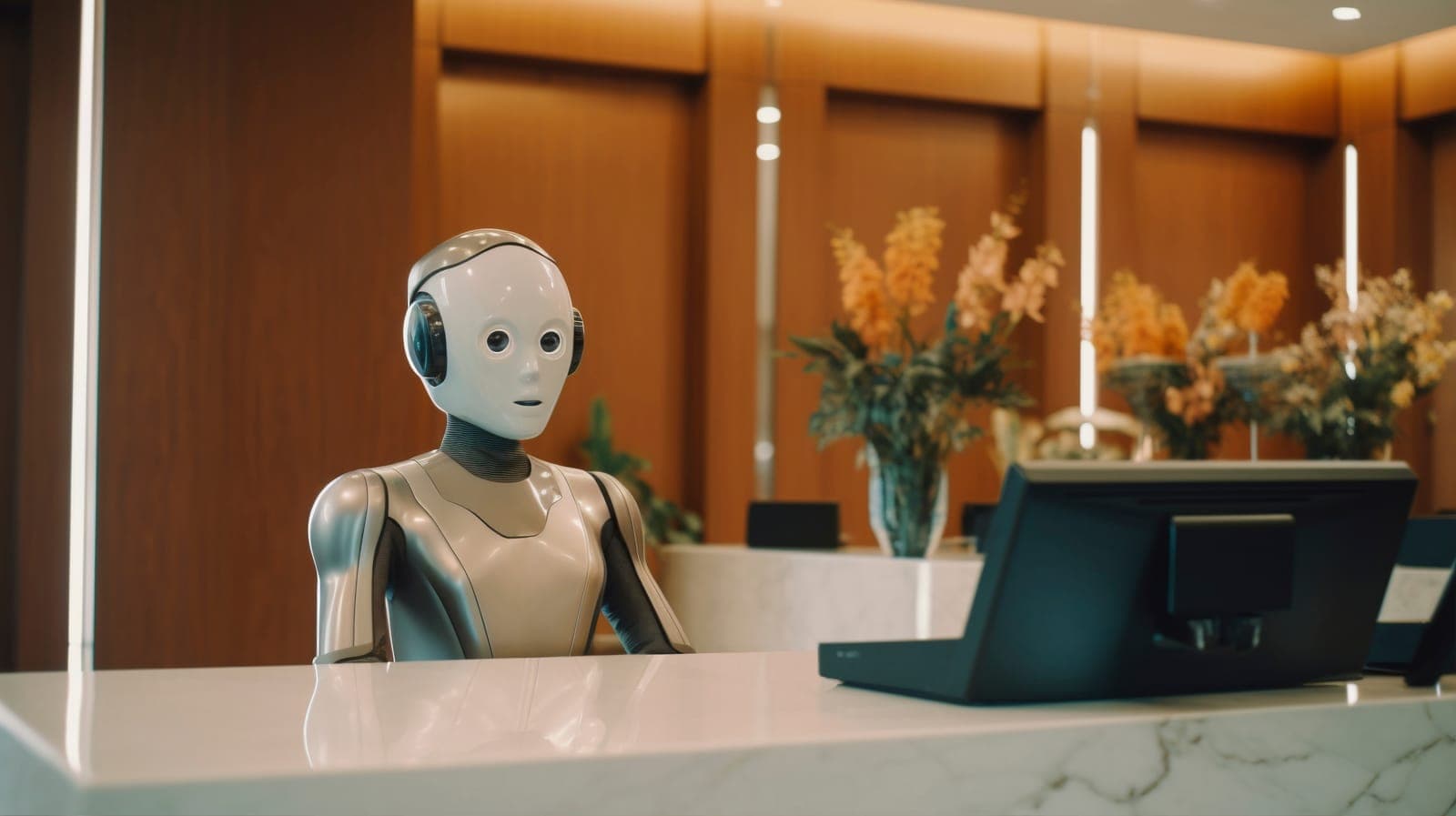
AI Phone Receptionists Are Quietly Becoming The New Front Desk.
A few years ago, the idea of an AI handling guest conversations would have sounded ridiculous. Hospitality is built on human interaction, after all. But what's interesting is that Voice AI isn't replacing the front desk. It's handling the moments that often prevent staff from delivering great service in the first place.
Think about a typical day at a hotel, restaurant, or resort. Staff are checking guests in, answering questions, handling requests, solving problems, and managing operations. At the same time, the phone keeps ringing. Some callers want to make reservations. Others want to ask about pricing, availability, check-in times, event bookings, or directions. Those calls matter, but they also compete for the same limited staff attention.
This is where modern AI phone receptionists create enormous value. Instead of forcing guests into voicemail or long wait times, businesses can answer instantly, provide information, capture bookings, and escalate conversations when human assistance is actually needed. The result is faster service for callers and fewer interruptions for on-site teams.
We discussed this shift earlier in How AI Agents Help Small Businesses Compete With Larger Companies. The biggest advantage AI provides isn't replacing people. It's helping businesses stay available even when their teams are already busy helping customers.
Hospitality businesses that adopt Voice AI early are discovering something surprisingly simple. Guests don't necessarily need a human for every interaction. They need fast answers, smooth experiences, and confidence that someone is available to help.
The Future Of Hospitality Customer Service Is Always Available.
Every major customer-service innovation eventually follows the same pattern. At first, it feels like a competitive advantage. Then customers become familiar with it. Eventually, they start expecting it. Online booking followed that pattern. Mobile check-in followed that pattern. I believe Voice AI is heading down the exact same road.
A few years from now, guests probably won't be impressed that a hotel, restaurant, or resort answered immediately. They'll simply expect it. They'll expect questions to be answered instantly, reservations to be handled smoothly, and support to be available whenever they need it. Businesses that can't provide that experience may find themselves competing against organizations that effectively operate around the clock.
That's why I think many hospitality leaders are asking the wrong question. They're asking whether Voice AI is ready. From what I've seen, the technology has already crossed that threshold. The better question is whether businesses will adopt it before customer expectations make it mandatory.
Whether it's an ai voice assistant, intelligent AI phone receptionists, advanced voice synthesis ai, or modern Voice AI systems built on powerful Voice api infrastructure, the direction seems increasingly clear. Hospitality customer service is moving toward immediate, personalized, and always-available communication.
The future won't belong to the hospitality businesses with the biggest teams. It will belong to the businesses that make guests feel helped the moment they reach out.
Deliver Five-Star Service Before Guests Even Arrive
See how RhythmiqCX helps hotels, restaurants, resorts, and hospitality businesses answer calls instantly, capture bookings automatically, and stay available 24/7 with AI voice assistants and intelligent AI phone receptionists.