Restaurant Owners Are Asking The Wrong Question.
"The debate shouldn't be AI versus humans. The debate should be where each one performs best."
Every time I hear someone ask whether an AI phone receptionist is better than a human host, I think they're starting from the wrong place. The conversation usually becomes emotional very quickly. People imagine robots replacing hospitality, removing personal service, and turning guest experiences into automated transactions.
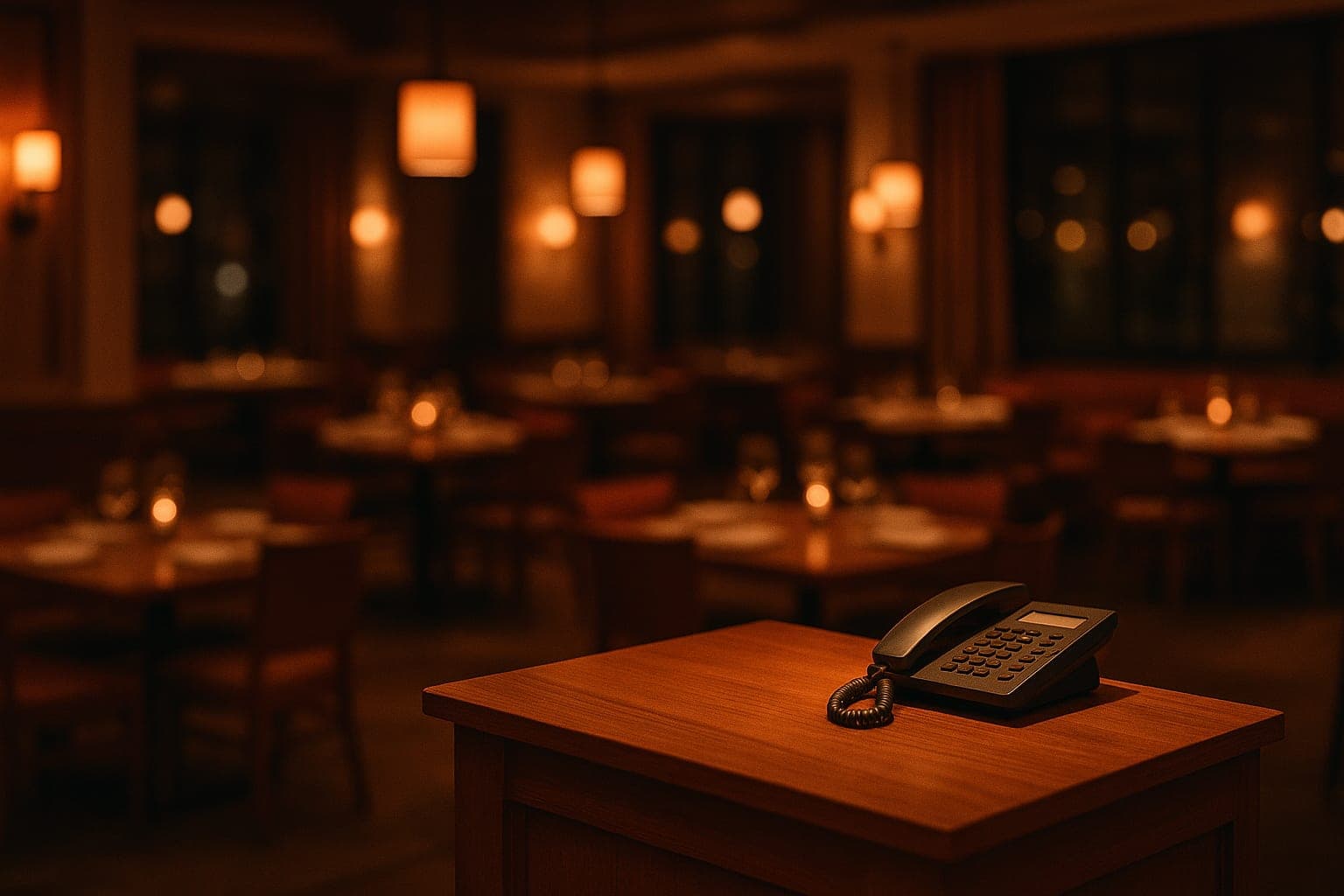
In reality, that's not what most restaurants are trying to do. They're trying to solve a much simpler problem. Customers are calling when staff are already busy. Phones ring during dinner rush. Reservation requests arrive after hours. Questions come in when employees are helping guests inside the restaurant.
That's why restaurants are increasingly adopting AI receptionists for restaurants and restaurant call answering services. Not because they want fewer people. Because they want fewer missed opportunities.
We explored this recently in The Real Cost of Missed Restaurant Calls. Most restaurants never see the customers they lose because nobody answered the phone.
So instead of asking whether AI should replace hosts, I think the better question is this: where does a human host provide the most value, and where does an AI phone receptionist outperform traditional call handling?
This Isn't Really AI Versus Humans.
One of the biggest mistakes businesses make when evaluating new technology is assuming every tool must completely replace something that already exists.
That's rarely how innovation works. Email didn't eliminate phone calls. Online reservations didn't eliminate walk-ins. Mobile ordering didn't eliminate dining rooms.
The same thing is happening with Voice AI. Modern AI voice assistants for restaurants aren't replacing hospitality. They're helping restaurants stay available when human teams simply can't be everywhere at once.
The real comparison isn't AI versus people. It's availability versus unavailability. And that's where things start becoming very interesting.
How Many Calls Are Being Missed During Your Busiest Hours?
See how RhythmiqCX helps restaurants answer every call, capture more reservations, and stay available 24/7 with an AI phone receptionist.
Where Human Hosts Still Win.
Let's start with something that often gets lost in AI discussions. Great hospitality is still a deeply human experience. The best hosts don't just answer questions. They read the room. They recognize returning guests. They calm frustrated customers. They handle unusual situations with empathy and judgment that software simply can't replicate.
If a guest arrives upset about a reservation issue, celebrating an anniversary, or dealing with a special request, a skilled host can turn that interaction into a memorable experience. That's one of the reasons hospitality businesses will always need great people.
Human hosts also excel when situations become unpredictable. Maybe a large party arrives unexpectedly. Maybe a reservation needs to be rearranged. Maybe there's a service issue that requires sensitivity and discretion. These are moments where experience and emotional intelligence matter far more than efficiency.
That's why I don't believe restaurants should think of AI as a replacement for hospitality. The best guest experiences are still created by people. Technology simply helps those people focus on higher-value interactions.
The reality is that customers don't remember the reservation process as much as they remember how they felt during the experience. Human hosts remain incredibly important for creating those moments.
Where AI Phone Receptionists Have A Clear Advantage.
While human hosts excel at hospitality, there are certain tasks where an AI phone receptionist simply performs better. The most obvious example is availability.
An AI system doesn't disappear during dinner rush. It doesn't stop answering calls because it's seating guests. It doesn't miss opportunities because the restaurant is busy. It answers immediately, every time.
That's why so many operators are adopting an AI receptionist for restaurants and intelligent restaurant call answering service solutions. They're not trying to replace staff. They're trying to make sure every customer gets a response.
Modern Voice AI for restaurants can answer frequently asked questions, collect reservation details, support restaurant reservation automation, and provide 24/7 restaurant call answering without increasing labor costs.
Today's systems are also powered by advanced speech to text api, Voice api, speech synthesis api, and text to speech ai technology. Customers can speak naturally and receive useful responses without navigating frustrating automated menus.
We're also seeing rapid improvements in ai voice technology, ai voice generator, voice synthesis ai, voice cloning software, ai voice cloning, real time voice cloning, instant voice cloning, and voice cloning api capabilities. Combined with conversational ai voice bot workflows and natural ai voiceover systems, the experience feels far more conversational than most people expect.
Personally, I think the biggest advantage isn't cost savings. It's consistency. Every customer gets an answer. Every call gets handled. Every reservation request receives attention. That's incredibly difficult for even the best human team to guarantee.
The Smartest Restaurants Don't Choose. They Use Both.
This is where I think the conversation gets interesting. Most restaurant owners assume they have to pick a side. Either hire more staff or deploy AI. Either trust people or trust technology. In reality, the most successful restaurants are increasingly combining both.
Human hosts and AI phone receptionists solve different problems. Hosts are exceptional at creating memorable guest experiences, handling sensitive situations, and building relationships. AI systems excel at answering calls instantly, handling routine questions, and making sure opportunities aren't missed when staff are busy.
Think about what happens during a dinner rush. The host is helping guests at the front desk. Servers are running food. The restaurant is operating at full speed. Meanwhile, the phone rings. In a traditional setup, that call may go unanswered. With an AI phone receptionist, the customer immediately receives assistance while the human team remains focused on the guests already inside the restaurant.
That's why I believe the smartest operators are using AI voice assistants for restaurants as a support layer rather than a replacement layer. The AI handles repetitive interactions. The team handles hospitality. Together, they create a much stronger guest experience than either could provide independently.
We touched on this idea in Why Restaurant Owners Are Switching to AI Phone Receptionists. The goal isn't fewer people. The goal is fewer missed opportunities.
The Future Isn't Replacement. It's Coverage.
Every major technology shift seems to trigger the same debate. People ask whether the new technology will replace the old one. We've seen it with online ordering, digital reservations, mobile apps, and self-service kiosks. The conversation around AI phone receptionists feels remarkably similar.
Personally, I don't think the future belongs entirely to AI, and I don't think it belongs entirely to humans either. The future belongs to businesses that remain available whenever customers need them.
That's why technologies like AI phone receptionists, restaurant call answering services, Voice AI for restaurants, and intelligent restaurant phone automation are growing so quickly. They're helping restaurants solve a problem that has existed for decades: customers calling when nobody is available to answer.
Combined with restaurant reservation automation and 24/7 restaurant call answering, restaurants can stay responsive during busy periods, after-hours, weekends, and holidays without dramatically increasing staffing costs.
The restaurants that continue viewing AI as a threat will likely miss the bigger opportunity. The restaurants that view AI as a tool for extending availability and improving responsiveness will be much better positioned to compete over the next few years.
At the end of the day, customers don't really care whether a human or an AI answered first. They care whether somebody helped them quickly.
The best restaurants won't replace hospitality with AI. They'll use AI to make hospitality available everywhere.
See How AI And Hospitality Work Better Together
Discover how RhythmiqCX helps restaurants combine AI phone receptionists, Voice AI, and human hospitality to answer more calls, capture more reservations, and stay available 24/7.